




If you’ve ever stared at your dog mid-bark and thought, “What are you actually trying to tell me right now?” — you’re not alone. And apparently, you’re also not wrong to wonder if tech might eventually help us figure it out.
This week, Traini, a Palo Alto–based pet tech startup, announced a $7.5 million funding round aimed at doing something pretty ambitious: building emotional intelligence for pets and translating it into language humans can understand.
You may also like: Top 5 Best Health Monitors for Dogs
The Big News (In Plain English)
Traini just closed a $7.5M round backed by serious tech money — including investors connected to NVIDIA, Anthropic, Xiaomi, and former execs from Google and Meta. Translation: this isn’t a novelty app with a cartoon bark-to-English converter. This is heavyweight AI funding real product development.
That money is going toward:
- Advanced AI research
- Product iteration
- Market expansion
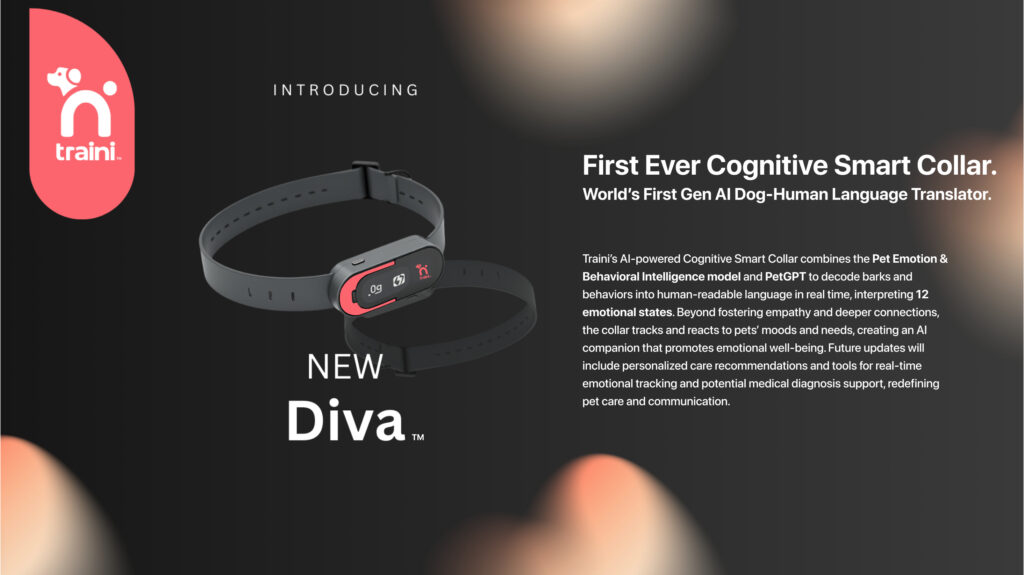
- And the launch of Traini’s first piece of hardware: the Cognitive Smart Collar
This collar is being billed as the world’s first cognitive pet wearable designed for real-time emotional understanding and two-way communication between dogs and humans.
Big claim? Absolutely. Interesting? Also yes.
So… Is This a “Dog Translator”?
Kind of — but not in the gimmicky way we’ve seen before.
Traini’s tech isn’t saying your dog is literally speaking English in their head. Instead, it analyzes behavioral and emotional signals — things dogs already communicate very clearly, just not in human language.
Here’s what Traini’s system looks at:
- Bark tone and vocal patterns
- Facial expressions
- Body movement
- Heart rate
- Temperature
- Activity levels
All of that feeds into Traini’s proprietary AI models, which translate those signals into emotional states like joy, anxiety, excitement, stress, or distress — and then present that information in conversational, human-friendly language.
The goal isn’t novelty. It’s understanding.
Meet PEBI: The Brains Behind the Collar
At the center of Traini’s ecosystem is something called PEBI (Pet Empathic Behavior Interface). This is the AI platform that powers everything.
PEBI uses multimodal generative AI, meaning it can process:
- Audio
- Video
- Images
- Text
By combining those inputs, it builds a real-time emotional and behavioral profile of your dog and turns it into insights you can actually use.
Traini says its models currently cover nearly 120 dog breeds, with reported emotion-translation accuracy reaching up to 94%. That’s not perfect — and no real-world behavior system ever is — but it’s far beyond the old “happy/sad bark” apps of the past.
Why This Matters to Pet Parents (Not Just Tech Nerds)
Here’s where this gets genuinely compelling.
Most pet parents don’t miss big problems. We notice limping. We notice vomiting. We notice when something is very wrong.
What we often miss are the early emotional and behavioral signals:
- Subtle anxiety
- Stress before it turns into reactivity
- Boredom that becomes destructive behavior
- Discomfort that hasn’t yet shown up as pain
Traini’s collar is designed to catch those early signals — and explain them in a way that helps you respond sooner.
Think:
- “Your dog is showing elevated anxiety patterns during afternoons.”
- “Your dog appears overstimulated after long play sessions.”
- “Behavioral signals suggest stress during your absence.”
That kind of feedback can change how you train, exercise, and care for your dog long before issues escalate.
There’s a Health Angle, Too
Beyond everyday communication, Traini is positioning this as a pet wellness and early-warning tool.
By continuously monitoring emotional and physiological data, the collar may help flag:
- Stress-related health risks
- Behavioral changes linked to pain or illness
- Emotional patterns that correlate with declining well-being
Traini already provides APIs to veterinary clinics and hardware companies, which opens the door to pet-assisted healthcare diagnostics and smarter integrations down the road.
This isn’t replacing your vet. But it could give you better information before you walk into the exam room.
Train-As-You-Use: Why the System Gets Smarter Over Time
One of the more interesting pieces of Traini’s approach is its “train-as-you-use” model.
Every anonymized interaction feeds back into the system:
- Improving personalization
- Expanding behavioral datasets
- Increasing accuracy over time
That creates a feedback loop where the product improves because real dogs are using it in real environments, not just lab conditions.
It also helps solve one of the hardest problems in pet AI: environmental complexity. Dogs don’t live in controlled spaces. They live in noisy, unpredictable human worlds.
A Quick Reality Check
Is this magic? No.
Is it perfect? Definitely not.
Is it promising? Very.
Pet tech has been inching toward emotional intelligence for years — activity tracking, sleep monitoring, behavior alerts. Traini is taking the next step by trying to interpret why those patterns exist, not just that they exist.
If it works as described, this could shift smart collars from “fitness trackers” to relationship tools — helping pet parents respond with more empathy, better timing, and fewer guesses.
And honestly? Anything that helps humans listen to dogs a little better is a step in the right direction.
The Bottom Line
Traini’s $7.5 million funding round signals growing confidence that pet emotional intelligence isn’t science fiction anymore. Whether this becomes a mainstream must-have or a niche tool remains to be seen — but it’s one of the most thoughtful, data-driven attempts we’ve seen so far.
We’ll be watching closely as the Cognitive Smart Collar rolls out — because if tech can help us understand our dogs just a little more clearly, that’s a future most pet parents would happily opt into.







Leave a Comment