




I already knew quite a bit about Freya thanks to her Embark Breed + Health Dog DNA test (and just living with her for 10 years). What I didn’t expect was for Embark to eventually start weighing in on why she behaves like Freya.
That’s basically the idea behind Embark’s Behavior Insights, available for Breed ID and Breed + Health customers. Instead of stopping at breed ancestry and health information, Embark now uses your dog’s genetic data to look at behavioral predispositions— the things they’re more likely to do — then compares those results with the dog you actually live with.
And yes, there are definitely moments when the DNA says, “Your dog may be inclined to do this,” and you think, Well, that explains a few things.
There are also moments when the DNA and the actual dog disagree. I found those just as interesting.

The Embark Breed + Health DNA Test does more than tell you your dog’s breed mix—it screens for 270+ genetic health conditions and offers detailed insights into traits, ancestry, and even potential relatives. Results are clear, thorough, and backed by veterinary research. If you want more than a fun guess at your dog’s background (and actually useful health info), this test is one of the most comprehensive options out there.
LIMITED TIME OFFER
GET $60 OFF BREED + HEALTH TEST
What Is Embark Behavior Insights?
Behavior Insights adds 15 genetic behavior scores to your dog’s Embark results, divided into five general categories:
- Around Other Dogs
- Around New People
- Out in the World
- At Home Alone
- When Feelings Get Big
Within those categories, Embark looks at tendencies involving things like reactivity, anxiety around unfamiliar dogs or people, sensitivity to loud noises, separation and confinement anxiety, hyperactivity, and obsessive or compulsive behaviors.
There’s an important distinction here: these aren’t diagnoses, and Embark isn’t saying DNA determines how your dog will behave.
The insights show genetic predispositions. In other words, your dog may be more or less likely than the average Embark-tested dog to display a particular behavior. Environment, experiences, socialization, and training still matter quite a bit.
And Embark doesn’t just hand you those insights and leave you with a fascinating new collection of facts about your dog. It also connects them to a personalized training plan through its partnership with the Dogo training app. So, if your dog is more likely to be reactive toward strangers or anxious around unfamiliar objects, for example, those insights can help shape the training exercises and lessons included in their plan.
That distinction becomes especially obvious once you actually go through the assessment.
First, Embark Asks About the Dog You Actually Know
Before showing you the full picture, Embark takes you through a behavioral questionnaire. I liked this part more than I expected.
Rather than simply handing me behavior insight and leaving me to decide whether they sounded like Freya, it asked specific questions about how she behaves in different situations.
For example, one question asked how often Freya is reactive when an unfamiliar dog enters our home, with reactivity defined as things like barking, growling, lunging, or becoming tense and difficult to settle.
The assessment covers all five behavioral areas, so by the time you’re finished, Embark has two different sets of information: what Freya’s DNA suggests she may be predisposed to do and what I say Freya actually does.
Then it puts the two together (nature & nurture). That is where Behavior Insights gets way more interesting than a dog personality quiz.
Freya’s Results Were…Pretty Freya
Some of Freya’s genetic results lined up well with the dog I’ve known for a decade. Her results showed that she’s 1.2x more likely to be anxious about loud noises. Observed.
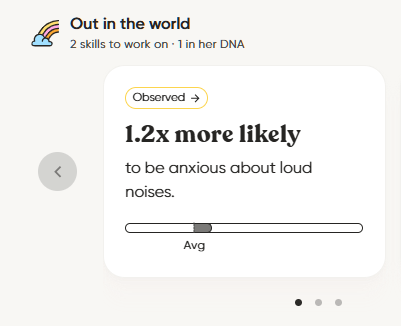
Anyone who has met Freya during a thunderstorm will be shocked to learn that I did not dispute this finding.
She also came back 1.9x more likely to be anxious around unfamiliar objects, which was another behavior I had observed.
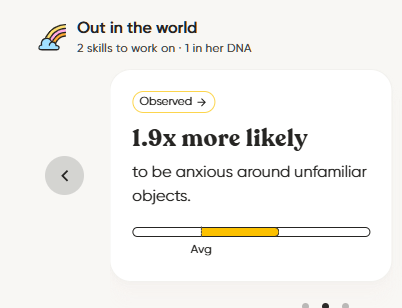
This is the same dog who can be remarkably brave about some things and deeply suspicious of an object that has apparently violated the terms of its lease by appearing somewhere she doesn’t think it belongs. She once refused to come into the house because we had a fan that she didn’t like in the living room.
But one of the things I appreciate about the way Embark presents these results is that it doesn’t pretend genetics are a crystal ball.
When the DNA and Your Dog Don’t Match, That’s Useful Too
One of Freya’s results showed that she’s 1.3x more reactive towards strangers on a leash. Except I marked that behavior as not observed. Freya LOVES meeting new people when she’s out on her walks.
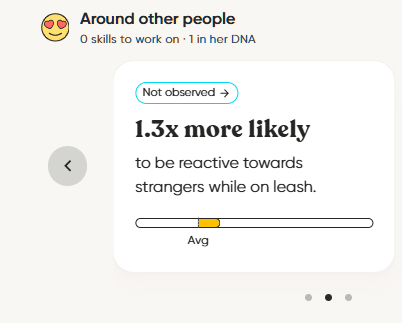
And that’s not a contradiction that Embark tries to explain away. According to Embark, differences between genetic insights and owner-reported behavior are actually useful information. A dog can have an underlying genetic tendency without ever developing the behavior. Environment, life experience, and training can all affect what ultimately shows up in real life.
I think that’s one of the smarter aspects of Behavior Insights.
DNA can tell you about the hand your dog was dealt. It can’t tell you exactly how every card gets played.
For a younger dog in particular, knowing about some of these predispositions before they become problems could also be helpful. If you know your dog is more likely to struggle with unfamiliar environments, for example, you can work on positive exposure and confidence-building before avoiding new places becomes an established pattern.
There Are 15 Behavior Insights in Total
The full Behavior Insights feature looks at quite a bit more than whether your dog is afraid of thunder or considers the UPS driver a sworn enemy.
The 15 scores cover anxiety and reactivity around unfamiliar dogs, anxiety and reactivity involving unfamiliar people, anxiety about unfamiliar places and objects, noise anxiety, separation and confinement anxiety, general anxiety and reactivity, hyperactivity, and obsessive or compulsive behaviors.
Each result is shown in relation to other Embark-tested dogs, so you may see that your dog is above average, about average, or below average for a particular tendency.
But Embark didn’t stop with telling us why our dogs may behave a certain way.
This is where its partnership with Dogo comes in.
Embark Behavior Insights Connects to Personalized Training Through Dogo
Once you’ve completed the Behavior Insights assessment, Embark can use the results to build a personalized training plan through the Dogo training app.

I was able to connect Freya’s Embark account with Dogo and see the personalized course it created for her. The process is integrated into the Behavior section of Embark, although the actual training takes place in Dogo.
Instead of dropping you into a giant library of generic dog-training lessons and telling you to have fun finding the relevant ones, Embark organizes a course around the areas identified through the Behavior Insights process.
Freya’s personalized Tailored Tails course, for example, included sections such as Fundamentals and Around Other Dogs, with lessons and exercises selected around her results, such as hand-feeding her.
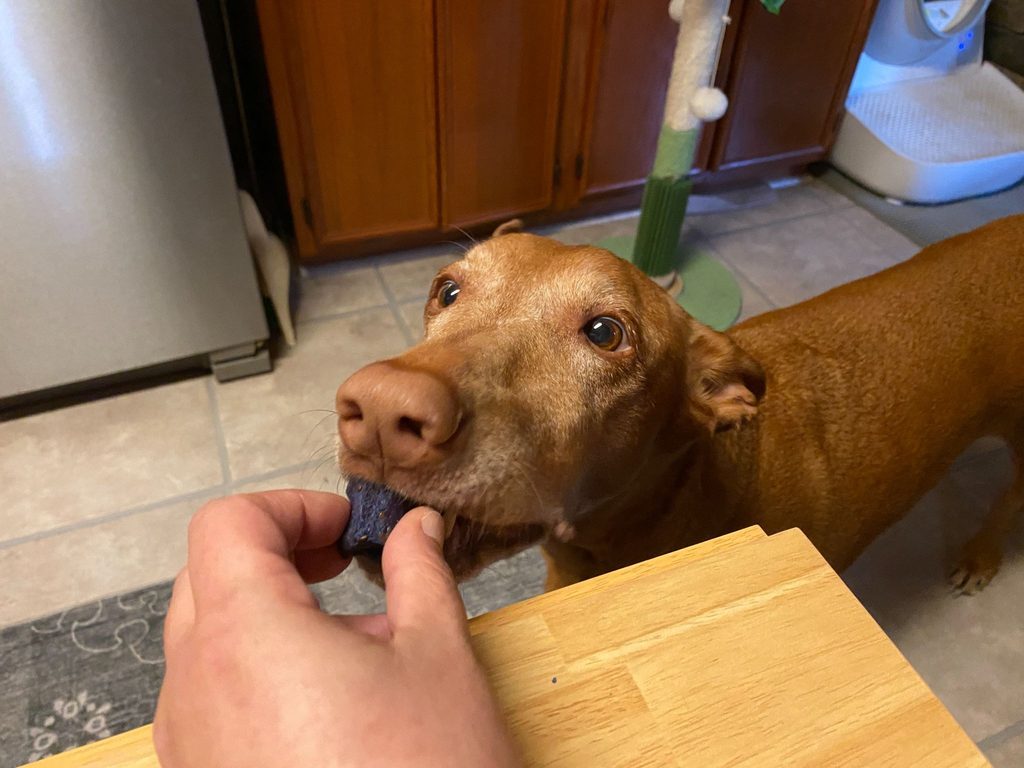
Embark lists specific training matches for different genetic insights. A dog predisposed to leash reactivity around unfamiliar dogs might get work involving leash walking, impulse control, desensitization, and “leave it,” while a dog predisposed to separation anxiety can be directed toward Dogo’s Home Alone course.
Dogo itself includes more than 100 training lessons and tricks, along with access to trainer feedback, activity and health tracking, and family sharing for up to five people.
I’m still working my way through Freya’s plan, so I’m not going to declare whether a DNA-informed training program is magically better than every other training app on Earth. (Also, Freya would like it noted that participation remains subject to her schedule.)
But I do like the logic behind it.
Breed results → behavioral tendencies → what you actually observe → relevant training.
It gives all that DNA data somewhere practical to go.
Oh, and don’t worry, the process of connecting to Dogo from Embark is SUPER easy. You do have to download the Dogo app. I was worried that meant spending 20 minutes signing up, filling out a profile, and somehow syncing the two apps. That wasn’t the case at all. After downloading Dogo, it automatically synced itself and I was ready to go in under a minute.
Is Embark Behavior Insights Actually Useful?
After going through Freya’s results, I think the most useful part isn’t having Embark tell me things I already know.
I don’t need a DNA test to tell me that Freya doesn’t enjoy loud noises. The trembling dog attempting to crawl under my desk every time thunder rolls in has communicated that information pretty clearly.
What is interesting is seeing which tendencies have a genetic component and, perhaps more importantly, seeing the ones that don’t match her current behavior.
That turns Behavior Insights into something more useful than “look at this funny thing your dog’s DNA says.”
If I were doing this with a newly adopted dog, especially one whose history I didn’t know very well, I think I’d find it even more valuable. You aren’t getting a prediction of everything that dog will ever do. You’re getting some clues about areas where they may need a little more patience, support, training, or positive exposure.
And sometimes knowing what might be difficult helps you avoid accidentally making it harder.
How Much Does Embark Behavior Insights Cost?
Behavior Insights is an add-on to Embark’s Breed ID and Breed + Health tests, rather than a completely separate DNA test.
Eligible customers receive one behavioral insight for free. Unlocking the remaining 15 genetic behavior insights also includes a one-year Dogo training subscription. Embark lists the public price for the add-on as $39 at launch.
You’ll also need to have received your dog’s Embark breed results before Behavior Insights becomes available.
If you already have Embark results, that makes this considerably more interesting because you don’t need to swab your dog again. The genetic data is already there. Embark is essentially finding a new way to use it.
My Take on Embark’s New Behavior Insights
I went into this mostly curious to see whether Embark’s DNA predictions would recognize the dog I know. For the most part, they did.
What surprised me was that I actually found the mismatches just as interesting as the obvious hits. Seeing that Freya has a higher genetic predisposition toward a behavior I’ve never observed is a good reminder of what these results can and can’t tell us.
Your dog’s genes influence behavior. They aren’t a script.
That’s also why I like that Embark paired the genetic results with an owner assessment instead of treating the DNA as the final word. You know the dog standing in your kitchen staring at you because dinner is apparently seven minutes late. Embark knows something about the genetic tendencies underneath that dog. Behavior Insights tries to put those two pieces together.
The Dogo integration gives it a practical next step, particularly for people dealing with behaviors they’d actually like some help with rather than merely wanting an explanation for them.
For someone who already has an Embark test, it’s a genuinely interesting expansion of what you can learn from the same DNA sample.
And apparently Freya’s suspicion of loud noises and unfamiliar objects has at least a little genetic backup.
I assume she’ll be citing that the next time something has the audacity to exist unexpectedly in her general vicinity.
For the weirdo you love.

The Behavior Insights feature is a new Embark add-on available with the Breed ID and Breed + Health Test. Terms apply.
The Embark Breed + Health DNA Test does more than tell you your dog’s breed mix—it screens for 270+ genetic health conditions and offers detailed insights into traits, ancestry, and even potential relatives. Results are clear, thorough, and backed by veterinary research. If you want more than a fun guess at your dog’s background (and actually useful health info), this test is one of the most comprehensive options out there.
LIMITED TIME OFFER
GET $60 OFF BREED + HEALTH TEST







Leave a Comment