




Dogs can’t tell us when something feels different, and the signs aren’t always obvious. A little less activity, a change in sleeping habits, or subtle differences in breathing can be easy to overlook, especially when they develop gradually.
For senior dogs and those living with chronic health conditions, paying attention to these changes is particularly important. Continuous health monitoring through the a collar like the PetPace Smart Collar can help us recognize patterns we might otherwise miss, giving us a clearer picture of how our dogs are doing between veterinary visits.
But what can that information actually tell us, and how can we use it to make better decisions about their care? Read on to find out.
The PetPace Smart Collar is a high-tech health tracker for dogs that monitors vital signs, activity, stress, and sleep—all in real time. Designed for comfort and built with vet-grade technology, it syncs with an easy-to-use app to give pet parents peace of mind and early alerts for potential health issues. Ideal for senior dogs or pets with medical conditions, it’s a powerful tool for proactive care in a sleek, wearable design.
⭐ GUARANTEED BEST PRICE ⭐
USE COUPON CODE TECHNO10 AT CHECKOUT TO SAVE 10%
Why I Started Paying Closer Attention to My Dog’s Health
One of the hardest things about caring for a senior dog is figuring out which changes are part of getting older and which ones might mean something more.
Is your dog sleeping more because they’re aging, or because something is bothering them? Are they becoming less active because they’ve finally decided squirrels aren’t worth the effort, or because moving around has become uncomfortable?
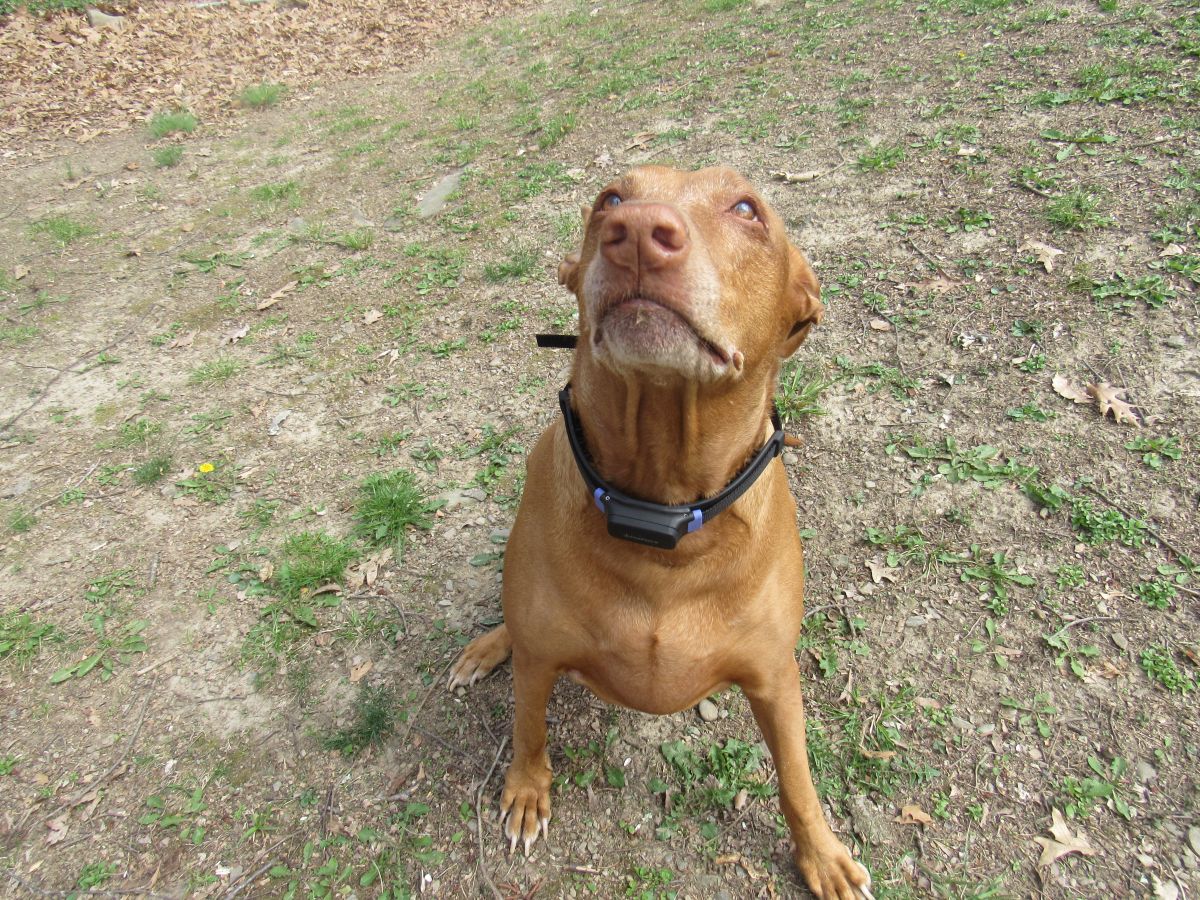
Those questions become even more complicated when your dog has a chronic health condition. I’ve been thinking about them quite a bit since my Pharaoh Hound, Freya, was diagnosed with heart disease in June 2026.

Freya is ten, so she’s both a senior dog and a dog living with a chronic illness. She takes several heart medications, and we’ve had to adjust her activities after she experienced episodes of weakness and collapse following physical exertion.
The problem is that Freya hasn’t gotten the memo about her limitations. She still wants to chase chipmunks, patrol the yard, and basically just behave like a much younger dog. Her enthusiasm hasn’t changed nearly as much as her physical capabilities.
I’ve been using a PetPace Smart Collar to monitor her heart rate, respiratory rate, activity, and rest patterns. While Freya’s experience involves heart disease, the benefits apply to many dogs.
A healthy twelve-year-old dog and a five-year-old dog with a chronic condition may have different needs, but both can benefit from understanding their individual health patterns.
Let’s look at what continuous health monitoring can tell you about your dog, why that information matters, and how it can help you and your veterinarian make more informed decisions about their care. This is a long one, my friends, so I’ll bold some key points and quotes.
Why Health Monitoring Matters for Senior Dogs and Dogs With Chronic Illnesses
Veterinary care has come a long way, but there’s still one fairly obvious limitation. Your vet only sees your dog for a tiny fraction of their life. Even dogs with chronic conditions spend most of their time at home, where subtle changes can be easy to miss.
Plus, dogs aren’t particularly good at telling us when something feels different. Some are expressive about discomfort. Others carry on as though nothing is wrong. Then there’s Freya, who will unleash the sighthound scream of death if a cat accidentally brushes against her but act perfectly fine with a twisted hock.
Dr. Asaf Dagan, Chief Veterinary Officer and co-founder of PetPace, says this tendency to hide illness helped inspire the technology.
“Pets are natural masters at hiding pain and illness, and by the time clear physical symptoms appear and a client brings them to the clinic, a condition has often already progressed significantly,” he explained.
For senior dogs, their health isn’t just about managing individual diseases; it’s also about maintaining comfort, mobility, and quality of life.
As Dr. Monica Tarantino, DVM, MBA, co-founder of the Senior Dog Veterinary Society (SDVS), explains, “Geriatric care goes beyond treating individual diseases. It’s about recognizing changes early, managing multiple conditions, preserving mobility and muscle, and helping dogs continue doing the things they love.”
That’s where monitoring everyday changes becomes valuable. For senior dogs, health trends may help us recognize changes we’d otherwise dismiss as aging. For dogs with chronic illnesses, they can provide additional information about how they’re doing between appointments.
Of course, health monitoring doesn’t diagnose or treat a condition on its own. It provides information that can support better-informed veterinary care.
So, what can all that data actually tell us? Let’s take a look, starting with a peek at the PetPace Health Dashboard.
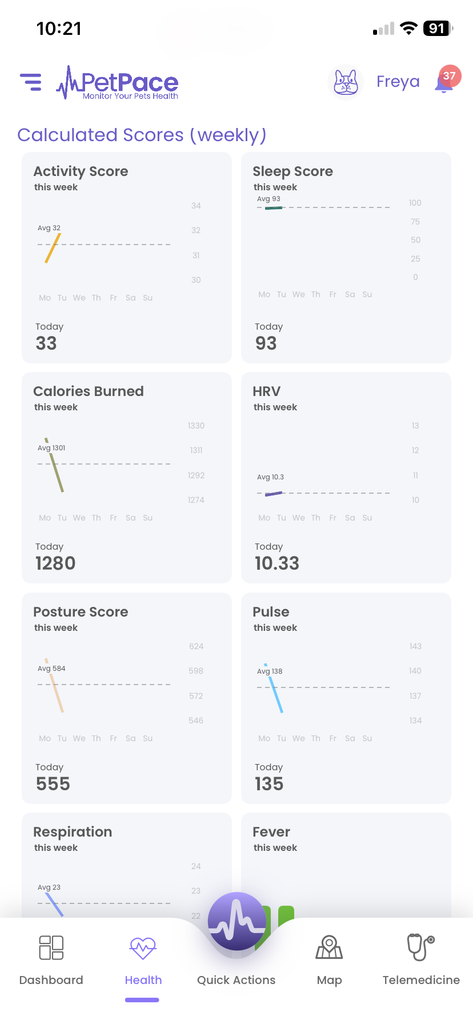
1. What Are My Dog’s Resting Vitals?
Your dog is lying on the sofa, apparently doing absolutely nothing. How much information could you possibly learn from that? Quite a bit, actually. Resting periods offer opportunities to observe heart rate, breathing, sleep quality, and changes in preferred resting positions.
Resting Heart Rate
A dog’s heart rate naturally fluctuates throughout the day. Exercise, excitement, stress, and even something interesting happening outside can influence it.
Freya is a good example. She can go from completely asleep to barking like crazy because a chipmunk walked across the deck. How she knows it’s there through a closed door, with her eyes shut, remains one of life’s great mysteries.
That’s why resting heart rate is most useful when measured under reasonably consistent conditions, when your dog is actually resting. For us, that’s usually the middle of the night when we’re also resting. Fortunately, health monitoring collars don’t need to sleep.
If your dog’s resting heart rate is typically within a certain range, a sustained change may be worth discussing with your veterinarian. It doesn’t automatically indicate a problem, but it provides another piece of information.
For Freya, having historical heart rate data has become particularly useful since her diagnosis. I can compare her earlier patterns with what I’m seeing now, while accounting for her medications and current condition.
Resting Respiratory Rate (RRR)
Breathing is another important measurement, especially for dogs with certain heart or respiratory conditions. Respiratory rate is simply the number of breaths a dog takes per minute. You can measure it yourself by counting chest movements while your dog is sleeping or resting quietly.
Veterinarians sometimes recommend tracking sleeping respiratory rate in dogs with heart disease because a sustained increase can indicate that their condition needs reassessment.
PetPace monitors respiratory rate throughout the day. Although it doesn’t specifically separate out RRR, I can look at Freya’s nighttime measurements to get a better picture of her breathing while she’s resting.
The important thing is to look at trends and circumstances rather than assuming one elevated reading means something serious. However, it goes without saying that if your dog is clearing struggling to breathe, it’s an emergency no matter what a monitoring device shows.
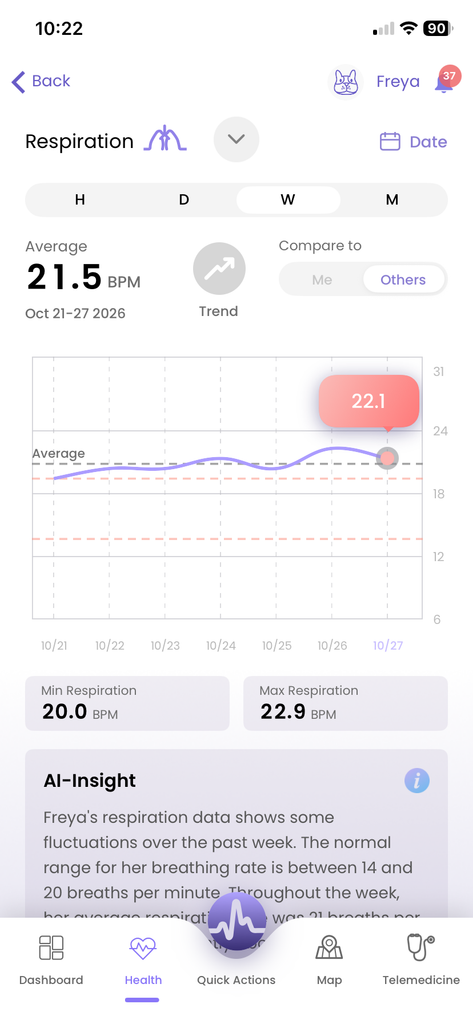
Quick note- While PetPace’s normal range is between 14-20 breaths per minute, my vet goes by the 14-30 range. As long as Freya stays under 30 it’s considered a normal range for her.
Resting Positions and Comfort
Some dogs sleep curled into a ball. Others stretch across the entire sofa as though they personally purchased it. Changes in those preferences can sometimes provide clues about comfort.
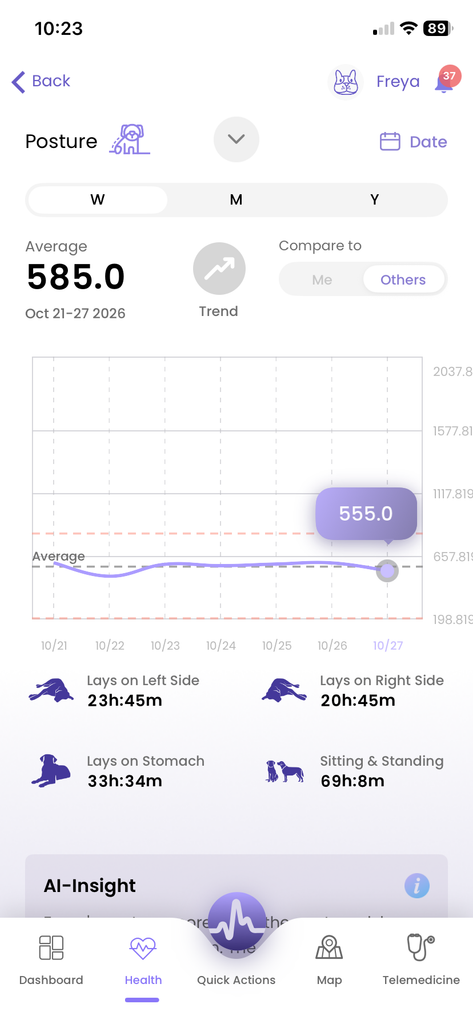
A dog with joint pain might avoid certain positions, change positions more frequently, or become reluctant to move once they’ve settled. PetPace tracks posture-related information, which can add context when considered alongside activity, sleep, and your observations.
Posture alone can’t tell you whether a dog is experiencing pain, but changes in familiar patterns may be worth investigating.
2. Is My Dog Becoming Less Active?
Most dogs slow down somewhat as they age. But there’s a difference between gradually losing interest in intense exercise and becoming less active because something hurts.
Dr. Tarantino says slowing down is one of the most commonly overlooked signs of potential health problems in senior dogs.
“I’ll have pet parents tell me their dog is doing great for their age, but then mention they’ve stopped going on walks, struggle with stairs, or need help getting into the car.”
Those changes can indicate pain or declining mobility rather than simply old age. She also points out that dogs can lose significant muscle mass without losing weight.
This isn’t exclusively a senior dog concern. Younger dogs with arthritis, heart disease, or other chronic conditions may experience similar changes.
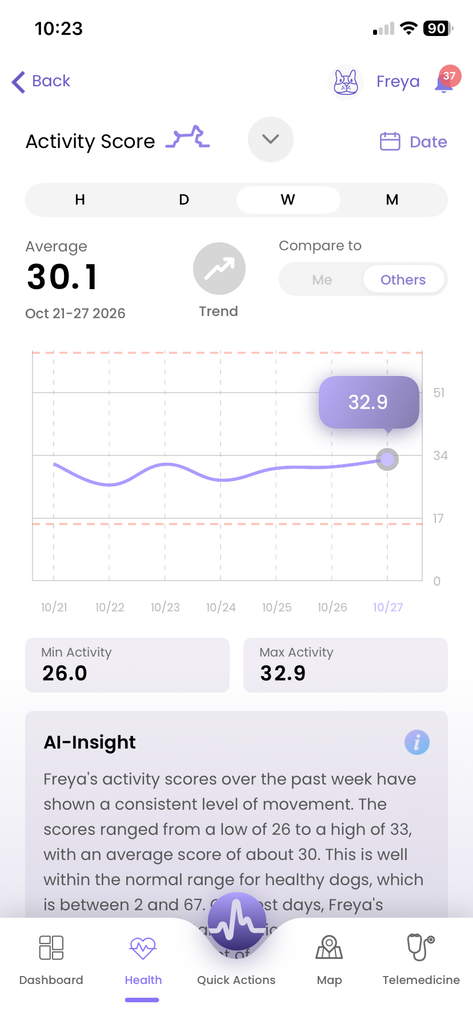
Why Activity Trends Matter
Activity monitoring helps you compare your dog’s current behavior with previous weeks or months.
If a normally active dog gradually starts moving less, even though their routine hasn’t changed, that’s worth paying attention to.
With Freya, activity monitoring has become less about whether she’s slowing down and more about how her body responds to what she does. She’s still extremely interested in chasing wildlife. Unfortunately, her heart disease means certain types of exertion can be dangerous.
When she was first diagnosed, I went a little overboard trying to protect her. I restricted her to a tiny patch of yard, stopped taking her on walks (we live on a mountain, so every walk involves hills), and basically put her in a bubble.
This was despite her veterinarian specifically telling me to “still let her be a dog.” He was right. By trying so hard to keep her safe, I was taking away nearly everything she enjoyed.
So, I gradually loosened the restrictions, trying to find a balance between protecting her health and letting her enjoy life.
Then she had another presyncope episode after an intense chipmunk chase. Her veterinarian had warned me that episodes could still happen and told me not to freak out. Yeah, I still totally freaked out.
Dr. Dagan said something about Freya’s situation that really clicked with me:
“For a senior dog with a diagnosed heart condition who is stabilized on cardiac medications, she feels energetic enough to chase chipmunks, but her heart has clear physical limits. As pet parents, we want them to enjoy life, but we need to know where that safe threshold lies.”
That’s exactly the challenge. PetPace lets me compare her activity with measurements such as heart rate and heart rate variability (HRV), giving me additional information about how her body responds to exertion.
Having that information helps me recognize patterns without restricting every little thing out of fear. Freya is much happier. She’s not thrilled that I won’t let her race after Mr. Chippy Chipper, but she has more freedom, and her world isn’t nearly as small.
PetPace also offers access to 24/7 veterinary telemedicine consultations, providing another option for discussing concerning data. For urgent symptoms, including collapse or breathing difficulties, I’d still seek immediate veterinary care.

3. How Can Monitoring Help With Chronic Disease Management?
Many chronic conditions require ongoing treatment, veterinary evaluations, and adjustments to a dog’s routine. The challenge is understanding how well they’re doing between appointments.
Dr. Dagan explained, “Managing a chronic condition is dramatically improved when caregivers have continuous, accurate data from the pet’s natural home environment, rather than relying solely on sporadic clinic rechecks.”
The value isn’t that a collar can independently determine whether treatment is working. It’s that recorded trends can provide additional information for your veterinarian to consider.
Heart Disease
For dogs with heart disease, monitoring resting or sleeping respiratory rate, activity tolerance, and certain cardiovascular measurements can be particularly useful, depending on their diagnosis.
PetPace also monitors HRV, which measures variation in the time between heartbeats. HRV can be influenced by stress, illness, activity, and other factors, so higher or lower readings aren’t automatically good or bad.
For Freya, I’m interested in how her heart rate, breathing, and activity patterns change over time. Having historical measurements gives me something to compare against, and it gives her veterinarian additional information about her everyday life.
That’s especially helpful because Freya has incredibly strong and dramatic objections to veterinary appointments. Her anxiety can affect the measurements collected during a visit.
Home monitoring offers another perspective on what her physiological patterns look like when she’s relaxing in her own environment.
Arthritis and Chronic Joint Pain
Arthritis is another condition where monitoring trends can be useful. Dogs with chronic joint pain don’t always limp. Some become less active, avoid certain movements, or change how they rest.
PetPace monitors activity, posture preferences, HRV, and an algorithm-generated Pain Score. These measurements can’t diagnose pain, but changes may provide useful clues.
Dr. Tarantino offered a practical example of how monitoring could help evaluate arthritis treatment: “We might start a new pain management plan, and at their next visit, their family says they seem better. But what if we also had data showing they’re more active and sleeping better?“
That information could help the veterinarian assess progress alongside the owner’s observations and follow-up examinations.
It works both ways, too. If a dog who’s been doing well becomes less active or increasingly restless at night, it may be time to reassess their comfort or treatment plan.
Other Chronic Conditions
Heart disease and arthritis aren’t the only conditions where monitoring may be useful. Respiratory illnesses, neurological conditions, and other long-term health problems can influence activity, sleep, or physiological measurements.
Which information matters depends on the condition. That’s something to discuss with your veterinarian, since wearable data complements rather than replaces examinations and diagnostic testing.
4. Is My Dog Sleeping More or Differently?
Senior dogs often sleep more than younger dogs, but there isn’t one universal definition of normal. Sleep needs vary by age, breed, health, activity level, and individual preferences. What matters is recognizing changes in your dog’s usual patterns.
A dog experiencing pain might struggle to get comfortable or wake frequently. Dogs with cognitive dysfunction may become restless at night, while chronic illnesses, medications, and other factors can also affect sleep.
Dr. Tarantino recommends paying attention to nighttime restlessness, panting at rest, increased anxiety, and changes in how senior dogs interact with their families. These changes can be subtle, particularly when they develop gradually. PetPace tracks sleep-related patterns, which can help document those changes.
Freya spends a good amount of time resting, but that’s always been common for her. She plays hard and sleeps hard. Even if “playing hard” has mellowed out over the years. Knowing her usual rest patterns makes it easier to recognize when something is different.

5. Are My Dog’s Vital Signs Changing?
One of the biggest advantages of continuous monitoring is establishing what’s typical for your individual dog. Dr. Dagan explained why this matters He says, “Every animal is physiologically and behaviorally distinct, so having a clear picture of what ‘normal’ looks like for a specific pet gives us an invaluable point of reference.”
Dr. Tarantino offered an excellent example involving sleeping respiratory rate: “Let’s say a dog’s sleeping respiratory rate has consistently been around 16 breaths per minute, and over several days it starts increasing to 25 or 28. Those numbers may not seem alarming on their own, but for a dog with certain heart conditions, that change from their normal could be important.”
That’s the value of a baseline. A measurement might not appear alarming in isolation but could represent a meaningful change for that particular dog. PetPace uses machine learning to evaluate measurements against a dog’s established patterns while also comparing them with relevant population data.
According to Dr. Dagan, those comparisons consider factors such as breed, age, weight, and clinical profile.
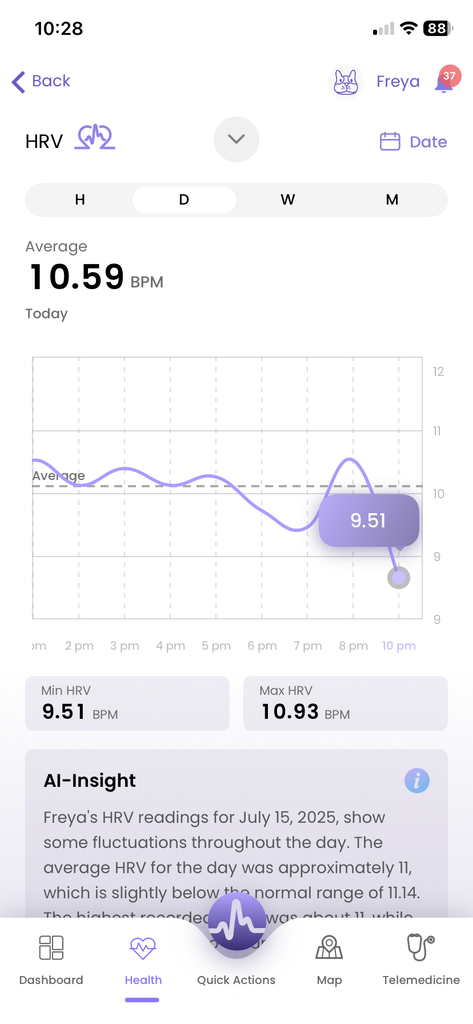
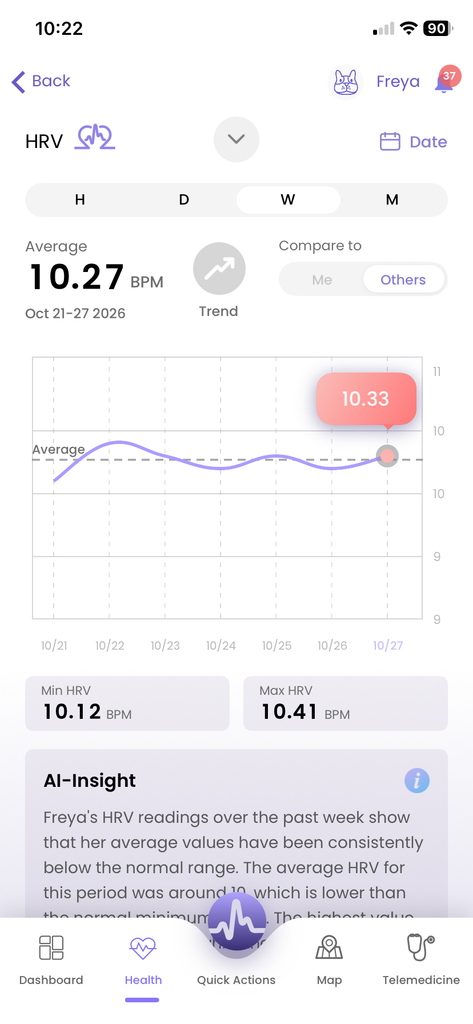
For context, here’s an example of Freya’s HRV back in 2025 before heart disease compared to her current score. Both are below the normal range but taken together the difference isn’t quite as alarming as just seeing that she’s below average now. Of course, individual baselines don’t override veterinary reference ranges, so even with context this deserves a discussion with your vet.
Why Baselines Matter Even After a Diagnosis
Ideally, you’d start collecting health data while your dog is healthy. But that isn’t always possible. Starting after a diagnosis doesn’t mean you’ve missed your opportunity. Dr. Dagan emphasized that even dogs already living with chronic conditions can benefit from establishing a personalized baseline.
Having a reference point for their current condition can help veterinarians recognize future changes and evaluate whether their care plan needs reassessment.
I’m grateful that I have PetPace data from before Freya developed heart disease. It provides valuable context when I compare her earlier measurements with her current ones.
But even if I’d started monitoring afterward, I’d still find value in understanding what her normal looks like now. After all, managing a chronic illness isn’t just about where your dog started. It’s also about understanding how they’re doing today.
6. How Can AI Help Make Sense of All This Information?
Continuous monitoring generates a lot of data. While I find health technology fascinating, I don’t particularly want to spend my entire day staring at charts trying to interpret every fluctuation. That’s where artificial intelligence can potentially help.
PetPace uses AI-based analysis to evaluate multiple physiological and behavioral measurements together, looking for patterns that might be difficult to recognize from individual readings.
Dr. Dagan explained, “Machine learning models can detect subtle patterns across complex, combined datasets—identifying novel parameters and cross-metric correlations that clinicians would never have previously suspected.”
In practical terms, the goal is to help identify potentially meaningful changes without expecting pet parents to interpret every measurement themselves.
PetPace’s algorithms are designed to consider patterns across multiple measurements, helping distinguish ordinary fluctuations from changes that may deserve attention.
7. What Information Should I Share With My Veterinarian?
This might be one of my favorite practical benefits of health monitoring. Your veterinarian sees your dog during appointments. You see your dog every day. But there’s a whole lot happening between those visits that your vet doesn’t get to see.
Dr. Tarantino put that into perspective with a statistic that really stuck with me. She said, “Think about this: we might see a dog for only an hour or two over an entire year. That leaves roughly 8,758 hours when we have very little idea what’s happening with them.”
Even during appointments, dogs don’t necessarily behave normally. The excitement and adrenaline of a veterinary visit can sometimes mask pain or mobility problems that are more noticeable at home. Home monitoring helps fill in some of those missing hours.
Still, even when you’re with your dog every day, remembering exactly when something changed isn’t always easy. Was your dog less active last week? Have they been sleeping more for a month? Did their resting heart rate change after starting a new medication? Recorded information can help answer those questions.
8. What Should I Do When My Dog’s Health Data Changes?
All this information is useful only if you know what to do with it. And this is where it’s easy to become a little too focused on the numbers.
Not every unusual reading is a reason to panic. Dogs are living creatures, not perfectly calibrated machines. When something changes, consider a few questions:
- Is it an isolated reading or an ongoing trend? Sustained changes may be more meaningful, although certain symptoms require immediate attention.
- What was my dog doing? Exercise, excitement, stress, and environmental conditions can affect measurements.
- Have I noticed other changes? Appetite, breathing, mobility, energy, and behavior can provide important context.
- Does my dog have an existing condition? Some changes warrant more immediate attention in dogs with chronic illnesses.
- Should I contact my veterinarian? When you’re uncertain, especially with a medically vulnerable dog, it’s worth asking.
If your dog experiences difficulty breathing, collapse, severe weakness, or other emergency symptoms, don’t wait for more data. Seek veterinary care immediately. Monitoring and alerts can be useful, but they aren’t substitutes for recognizing an emergency.
You Don’t Need Technology to Start Paying Attention (But It Sure Does Help)
While I’ve found PetPace incredibly useful for monitoring Freya, you don’t need a smart collar to start tracking your dog’s health.
The Senior Dog Veterinary Society recommends regular senior wellness visits, often every six months depending on individual needs. These appointments should evaluate mobility, muscle condition, pain, and cognitive health, not just routine bloodwork.
At home, you can take occasional videos of your dog walking or getting up from rest. Pay attention to whether they’re enjoying their usual activities, navigating stairs comfortably, and sleeping normally. Even notes on your phone can help you recognize gradual changes.
As Dr. Tarantino explained, “Wearable technology takes that a step further by collecting information consistently over time, potentially helping us recognize subtle changes we might otherwise miss.”
That’s exactly how I think about PetPace. It doesn’t replace what I notice about Freya every day. It gives me additional information, including physiological measurements I couldn’t continuously track on my own.
And whether you use a wearable or not, don’t assume that every change is simply part of getting older. As Dr. Tarantino puts it, “Aging itself isn’t a diagnosis.”

Final Thoughts: Better Information Helps Us Make Better Decisions
I know Freya pretty well. I know her habits, her routines, and her very strong opinions about what should and shouldn’t be allowed in her yard. But knowing my dog doesn’t mean I can see everything happening inside her body. That’s where health monitoring has become useful.
PetPace gives me another perspective on her well-being. It doesn’t replace veterinary care or answer every question, but it helps me recognize changes and have more informed conversations with her veterinarian.
While I’ve focused quite a bit on Freya’s heart disease, the benefits apply to other senior dogs and dogs living with many different chronic conditions.
The goal isn’t to turn every pet parent into a veterinarian or make every dog wear a health monitor. It’s to understand how our dogs are doing so we can make better-informed decisions about their care.
Getting older is inevitable, but that doesn’t mean every change should be dismissed as just old age. And when our dogs are managing chronic illnesses, having a clearer picture of their everyday health can help us give them the best quality of life possible.
The PetPace Smart Collar is a high-tech health tracker for dogs that monitors vital signs, activity, stress, and sleep—all in real time. Designed for comfort and built with vet-grade technology, it syncs with an easy-to-use app to give pet parents peace of mind and early alerts for potential health issues. Ideal for senior dogs or pets with medical conditions, it’s a powerful tool for proactive care in a sleek, wearable design.
⭐ GUARANTEED BEST PRICE ⭐
USE COUPON CODE TECHNO10 AT CHECKOUT TO SAVE 10%






Leave a Comment